
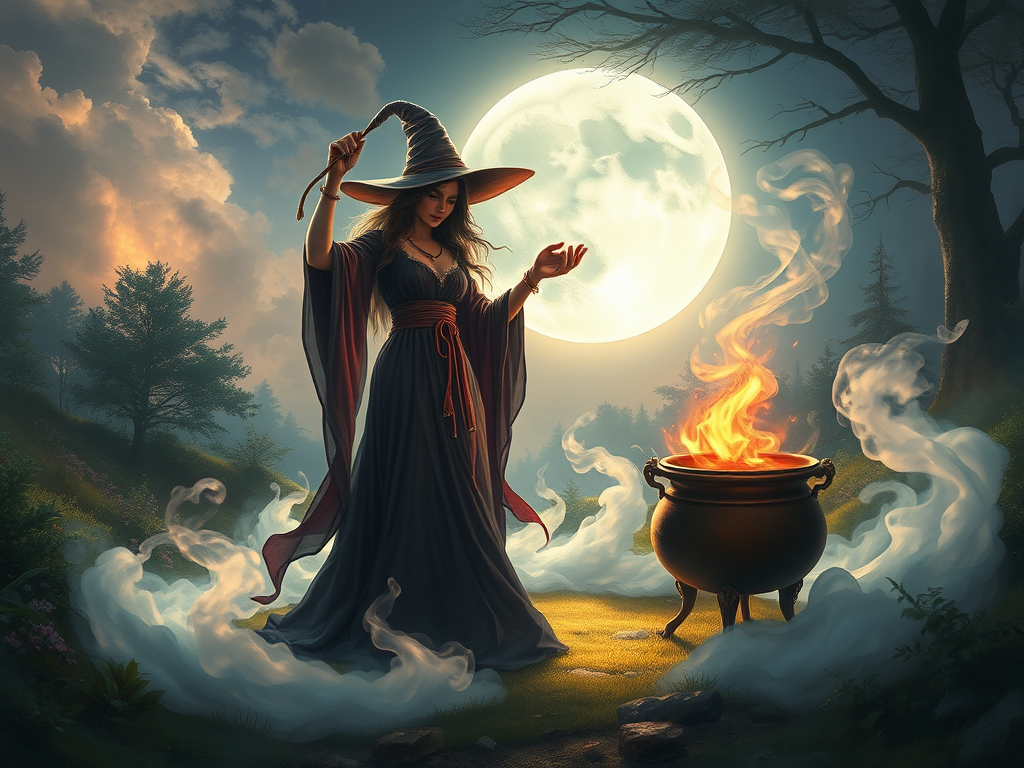
Magick is one of those words that carries both weight and wonder. It’s a word that has been misunderstood, misused, and misrepresented for centuries. But within the witchcraft community, it has a very specific meaning — one that deserves clarity and respect.
And yes, the K matters.
“Magic” is illusion. It’s entertainment. It’s rabbits in hats and boxes cut in half. Magick, with a K, is something entirely different. It’s not about suspending disbelief; it’s about leaning into belief. It’s about honesty, sincerity, and lived experience.
When I say I feel energy, I mean it. When I say I see something in a crystal ball, I’m not performing — I’m perceiving. The K marks that difference.
So what is magick?
Magick Is the Movement of Energy
At its core, magick is the movement of energy — not metaphorical energy, not symbolic energy, but the subtle, universal current that flows through all things. This energy is our relationship with the universe. It’s the medium through which intention becomes action, the bridge between will and manifestation, and the thread that connects all beings and all moments.
Dion Fortune famously wrote that “magic is the art of changing consciousness at will” [1]. But beneath that definition, she also described a universal “etheric force” that moves through all things. That deeper layer is where my understanding of magick lives.
Magick isn’t separate from the world. It’s woven into the world. It’s woven into us.
Where Does That Energy Come From?
The short answer: everywhere.
We don’t “own” energy. We don’t generate it in isolation. We participate in it. Some of the energy we use in magick is stored within our bodies, some is drawn from nature, some is shared between living things, and some flows through the universe itself. But none of it is separate. None of it is personal property.
A blood cell doesn’t “own” its energy. It moves because the heart moves. The heart moves because the body is nourished. The body is nourished because the world provides food. And the food grows because the sun gives light. It’s all one system. One flow. One source.
Magick works the same way.
Starhawk describes this beautifully when she writes about the “web of life,” a single interconnected field of energy that we touch, shape, and are shaped by [2]. That’s exactly how I experience it.
What Does a Witch Do With Energy?
A witch directs energy with focus. The direction is desire. The focus is intention. Correspondences — herbs, colours, crystals, symbols — don’t create magick; they sharpen it. They help us hold intention clearly, steadily, and with purpose.
Magick is not passive. It is action. It is the deliberate shaping of energy toward a desired outcome.
Christopher Penczak puts it simply: “Magick is the art of changing energy through intention” [3]. That’s the heart of it.
What Does Magick Feel Like?
The experience of magick isn’t one thing — it’s a spectrum.
High Ritual Magick — The Intensity
In big ritual work, the energy is powerful and consuming. You feel every cell in your body engaged. Your senses narrow to a single point. The world falls away. It’s like lifting something impossibly heavy or swimming underwater on one breath. It demands everything you have, and it leaves you exhausted in the way only real energetic work can.
Everyday Magick — The Flow
By contrast, smaller workings feel like floating in a stream. You’re aware of everything, drawing in the world around you, letting the current carry you, nudging the flow rather than wrestling it. It’s gentle, natural, and aligned.
Both states are magick. Both are real. Both are part of the craft.
Why Do We Do Magick?
To create change.
Maybe that change is in the world, in our circumstances, or within ourselves. Anyone can live in harmony with the universe. A witch actively collaborates with it. Magick is the art of working with energy to shape favourable outcomes — not through force, but through relationship.
The Ethics of Magick
Magick is a tool. A tool has no morality. The morality comes from the practitioner. A knife can prepare food or cause harm. Magick is no different.
A good practitioner avoids harm. A great practitioner has a strong moral compass — and the humility to know they are not always wise enough to see the universe’s full design. Ethics are not simple; they are situational. Does chemotherapy violate “do no harm”? Does an amputation? Is taking a job harmful to someone else? Is cutting a plant harmful? Is harm always wrong, or can it serve a greater good?
Every action has reactions. A witch must consider them. We try to do no harm — but it can take a lifetime to understand what that truly means.
Vivianne Crowley writes that humility is the foundation of ethical practice [4]. I agree. Humility keeps power from becoming ego.
The Role of Belief
Belief matters.
You need to believe in yourself, your relationship with the universe, and your ability to influence energy. Before you can believe in a spell, you must believe in you.
But belief in magick grows through experience. The first time you press a remote and a TV turns on, it feels impossible. Magick is the same. Small successes dissolve doubt. Each doubt removed strengthens the next working. Confidence snowballs.
And yes — you will falter. You will have moments of crisis. You will question everything you thought you knew. But rebuilding belief gets easier, faster, and stronger because you’ve lived it.
The Mystery of Magick
A witch should always question. Curiosity is part of the craft. As people grow, as science grows, as society grows, the mechanisms of magick may become clearer. But the feeling of magick — the sensation, the presence, the shift — will always remain a mystery.
We know love is a chemical reaction. We know neurons create memory and emotion. We know the brain has mechanisms. But the feeling of love is still a mystery.
Magick is the same. We may one day understand the “rainbow connection,” as Kermit said, but the experience will always be something deeper than explanation. The mystery isn’t in the mechanism. The mystery is in the meaning.
In the End
Magick is the movement of energy. It is intention made active. It is relationship made real. It is change made possible. It is both explainable and ineffable, both practical and mysterious, both ancient and evolving.
And it is yours to explore.
References
- Dion Fortune, The Mystical Qabalah (1935).
- Starhawk, The Spiral Dance (1979).
- Christopher Penczak, The Inner Temple of Witchcraft (2002).
- Vivianne Crowley, Wicca: A Comprehensive Guide to the Old Religion in the Modern World (1989).


Leave a Reply